


👋 Friends,
Today’s essay is about the advice I wish my mentors had given me 10 years ago.
Separately, see our schedule below for our LAST few events of the year. I hope to see you there!
Oct 26 | 🗽 The Shortlist: October Founder Showcase (NYC) – Meet the founders/CEOs of the fastest-growing tech companies in the city.
Nov 3 | 🎉 Outliers Kickoff Party (NYC) – Everyone welcome! Join our last tech mixer of the year and meet founders, operators & investors.
Nov 4 | ⭐ Outliers Summit VIP Day (NYC) – A half-day learning and networking session with Ankur Nagpal (Founder of Teachable, Carry and GP at AngelList), Julian Weisser (Solo Founders), and the Media Mafia.
Nov 4 | 🏃♂️ Outliers Run Club x Nadya Okamoto (NYC) – Join Nadya (CMO Pie & content creator w/ 6m followers) for her iconic run club!
Nov 5–6 | 🗽 The Outliers Summit (NYC) – A two-day gathering in New York for founders, builders, and creators bringing unreasonably ambitious ideas to life. Tickets sell out soon.
Nov 6 | 🎉 Outliers Summit Closing Party (NYC) – Hosted at Unveiled, one of the hottest nightclubs in Williamsburg.
Nov 9 | 🍽️ Junto Founder Dinner (NYC) – Apply to attend. Join a handpicked group of early-stage venture-backed NYC CEOs and founders for dinner on us.
Nov 19 | 🍽️ Future of Storytelling Salon (NYC) – Join a dozen brand leaders, marketing execs, and creators for a discussion on the future of storytelling looks like. Application only.
Dec 9 | 🍽️ Junto Founder Dinner (NYC) – Apply to attend. Join a handpicked group of early-stage venture-backed NYC CEOs and founders for dinner on us.
• • •
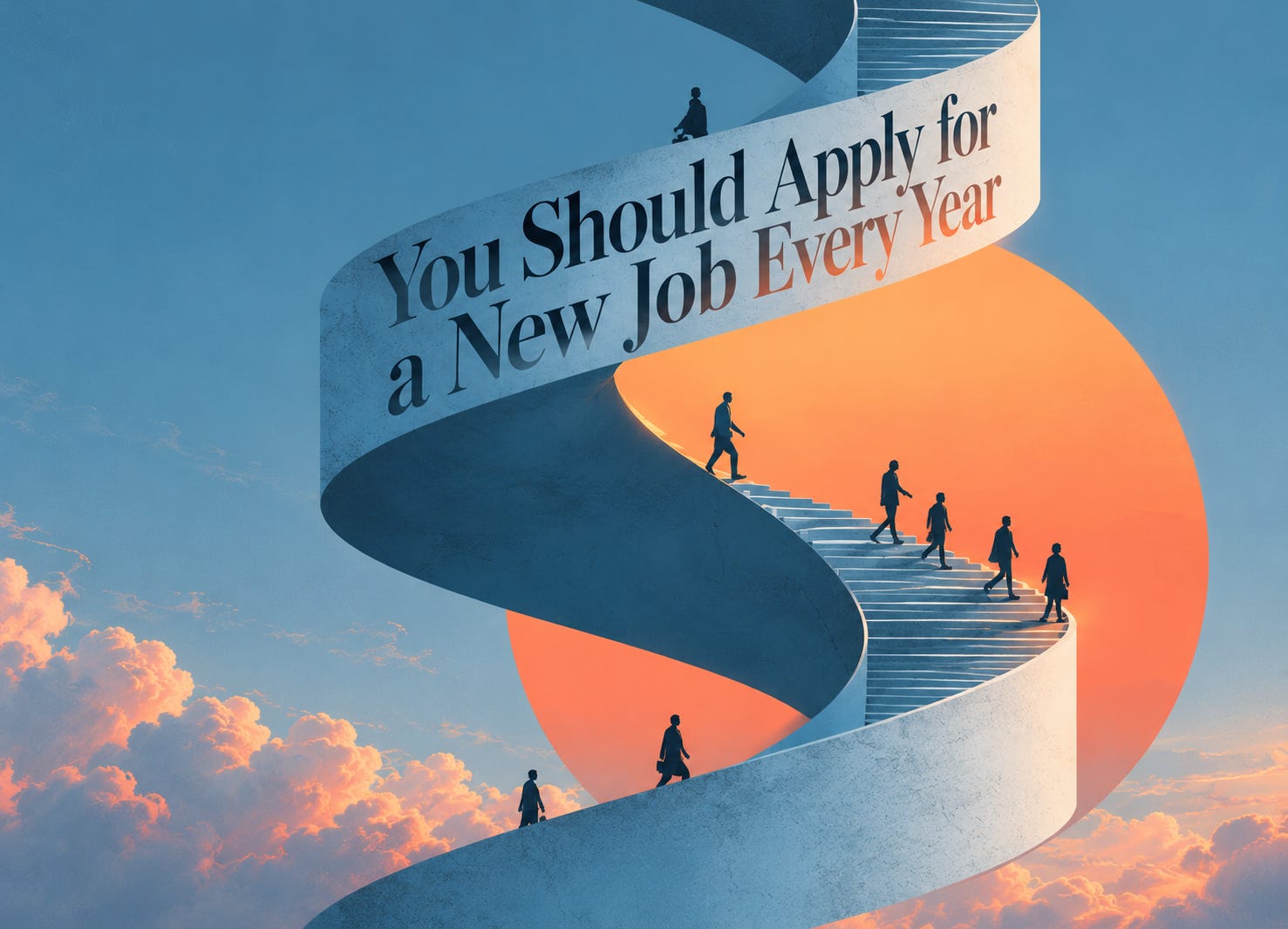
How do some people always seem to get promoted, get fancy job titles, blow past everyone else… and make it look effortless?
For a while, I thought the way to build your career was to work harder, get better, and wait to get promoted. I was wrong.
I started my career making $190 a day as an intern, then $45,000 a year in my first full-time job. It wasn’t until my mid-20s that I finally made six figures after learning the “game.”
In my spare time, I’ve coached over a hundred people on career leverage and salary negotiation. And though some of this can feel silly, the results aren’t. It can be the difference between making $125,000 and $225,000 for basically the same job.
Here are the things you can do to be an outlier:
Apply for a new job every year
My former boss revealed his strategy for getting a raise each year. Every year, he’d crush his role. He was so good that nobody could ignore him. But on top of that, he’d interview at other companies. Not to reveal secrets, but to assess his market rate. His goal was to stay in the 95th percentile of cash comp for his role. If he got a higher offer, he’d bring it back for leverage and ask for what he wanted. Politely, of course.
Know which waves to ride
I recently met the Chief Revenue Officer of one of the fastest-growing AI companies in the world and asked him how he always picked winning companies to work at. Before that, he was an early chief exec at three multi-billion-dollar companies. He said his VC friend always told him which winners to join, because at any given point, VCs have their eyes on hundreds of companies and an uncanny ability to spot breakouts.
The point isn’t to have friends in VC (although that may help). It’s about putting yourself in a position to spot winners. Winning teams get more money, grow bigger, and scale faster, which means if you’re on the team, you will too.
By the way, if you’re looking for these roles, we share them on The Shortlist.
Make your wins public
I’ll never forget the advice that my mentor gave me when I told him I was starting a job in America. He told me I needed to be LOUD – that if I wanted to advance my career and get more opportunities, I would need to speak up. The squeaky wheel gets the grease (or whatever the saying is)
So when I worked at Facebook, I’d obnoxiously send my manager a weekly email with all the stuff I’d accomplished. I’m sure it annoyed her, but not once did she wonder what I was working on. Within a year, I was promoted and got a 34% salary increase.
You should do this externally too. The biggest disservice you can do your future self is not sharing your wins publicly on LinkedIn. Not in a boastful way, but in a way that helps others. If you do this, I guarantee you will get showered with job offers.
Most people assume good work speaks for itself, but it doesn’t. Your work needs a spokesperson. That spokesperson is usually you.
Take ownership
You will never get promoted if all you do is follow instructions. You need to lead. The easiest way to start doing this is to find small pieces of the business that you can take complete responsibility for.
And over time, expand your scope. Do more. Take on more budget and take on more responsibility. If you start your career as a social media manager doing LinkedIn ads, ask if you can do Instagram too. Then eventually all the social media platforms. Then paid channels. Then events. Get the point?
As for promotions, every single leader I’ve spoken to thinks of promotions as lagging indicators. Which means you have to do the job long before you’re promoted into it.
Get close to whatever the company values most
A managing director at a top consulting firm once told me: stay close to where the company makes money. I’d expand that slightly: stay close to whatever the company cannot afford to fail at. The closer your work is to the core engine of the business, the easier it is for leadership to understand your value.
For most companies, it’s revenue. In tech, it might be the salespeople, product managers, and engineers. In other industries, it’s the investment bankers, management consultants, physicians, brokers, etc. These functions are often the lifeblood of the business.
You will always be treated well if you can create undeniable proof that you are bringing value to the business.
• • •
In summary, most career advice tells you how to become better at your current job. I think that’s only half the game.
The people I’ve watched move unusually fast are constantly increasing their leverage.
They know what the market will pay them. They put themselves inside growing companies and growing roles. They make their work visible. They take on responsibility before someone gives them permission.
And they don’t wait until they need a new opportunity to start creating options.
So yes, apply for a new job every year.
• • •
📌 Andrew’s Bookmarks
My favorite links to help you be wiser and more creative.
The Art of Cold-Emailing a Billionaire by Andy (Wandering Founder) – Andy has cold-emailed billionaires like Travis Kalanick and Eric Lefkofsky, and claims more than half respond. He shares four principles behind his success: establish credibility, make a clear ask, be upfront about what you want, and show you've put in the effort.
The Career Bets That Compound by Karan Dhir – The best career decisions can pay off for decades. Skills, relationships, and reputation become more valuable over time, especially when they open doors to opportunities you couldn’t have predicted. A useful reminder to think about where a decision might take you five or ten years from now.
Networking Is Overrated for Most People by Karan Dhir – Most people spend too much time collecting connections and not enough time building real relationships. Karan argues that 20 to 50 people who know your work and genuinely trust you are far more valuable than thousands of LinkedIn connections.
The Highest Leverage Career Decision by Akshay Ramachandran – Akshay spent eight months studying investing, then learned more in two weeks working with an exceptional mentor. His takeaway: Who you learn from can matter more than what you learn. Find someone exceptional, put in the work, and let their experience accelerate your growth.
• • •
🚀 Fewer than 100 Outliers Summit tickets left
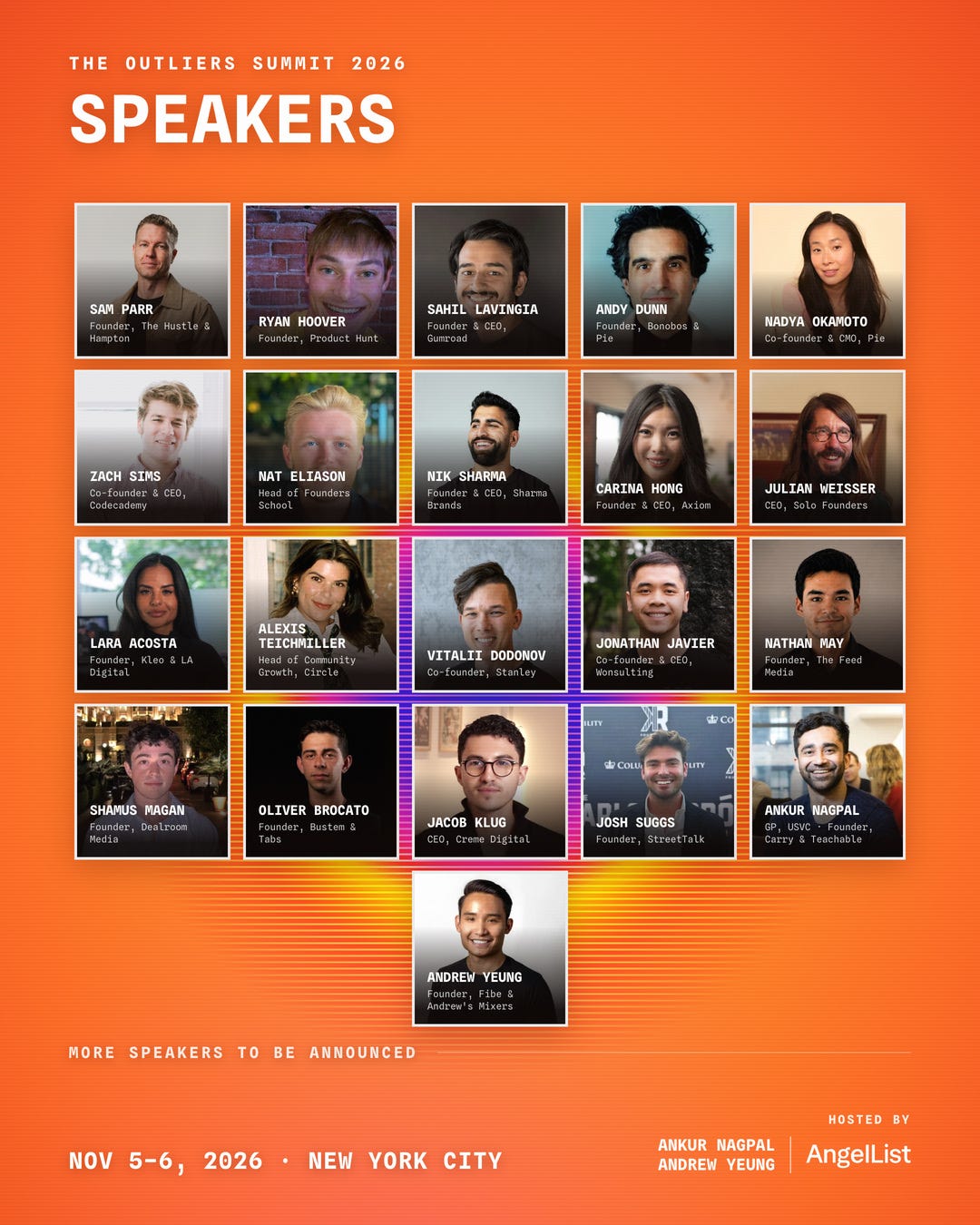
The Outliers Summit is three weeks away, and we’re close to selling out. There are fewer than 100 tickets left.
We just added 10 new speakers. Every one of them built a seven-, eight-, or nine-figure company, and they’re coming to show you exactly how. They join Sam Parr (sold The Hustle to HubSpot), Zach Sims (sold Codecademy for $525M), Ryan Hoover (sold Product Hunt to AngelList), and many more.
Day 1 is for building something real with AI. Day 2 is off-the-record talks from founders who’ve built, scaled, and sold. Plus parties and side events all week.
And every ticket comes with access to $100,000+ in partner credits from Vercel, ElevenLabs, Granola, Datadog, and more.
This is the best room we’ve ever put together. We’d love for you to be in it.
👉 Grab your ticket before we sell out
• • •
💃 Tech Community Plugs
Resources for entrepreneurs, investors, and tech professionals.
🤝 Happenstance is ChatGPT for working your network. I use Happenstance to build guest lists for my dinners and find founders and investors in any city. Connect your email, calendar and social accounts, give it a goal like ‘fill our three engineering roles,’ and it searches everyone you and your friends know until it finds the right people. It’s free, and code ANDREWYEUNG gets you a month of Pro at checkout. Try it here.
✍️ Your AI Head of Content. I’ve been using Stanley for months, and it’s the only reason I could run two companies and still grow 100K+ followers this year. It texts me what to post, tells me what’s working, and auto-schedules everything from my iMessage. Free to try for 30 days with code ANDREW here.
💼 Hiring top GTM & engineering talent in NYC? Apply to pitch at our monthly Shortlist founder showcase and meet the top 1% operators from my network.
🍽️ InKind – the ultimate dining app for foodies … earn up to 30% back when you eat out, plus get $50 off your bill every month at select spots. And as a bonus, we both get $25 free when you sign up. Sign up here.
🏢 Looking for an office space in NYC? I know of a few great spots opening up. Hit reply if you’re searching.
💡 Have a startup idea you’re seriously considering building? The Foundry is a 5-week sprint with Forum’s AI Venture Studio to stress-test it, confirm market demand, and get a straight answer on whether it’s worth pursuing. Strong candidates pitch for $250K. Kicks off November 10th. Apply here.
🧮 Need a CPA? I’ll introduce you to Alex, with whom I’ve been working for the past three years. He’s excellent and specializes in tax support for high-earning individuals and entrepreneurs. More info here.
🏦 Fidelity Private Shares is the best-in-class equity management platform with 409A valuations and a secure data room. With Fidelity Private Shares, you’re always fundraise-ready. To learn more, reach out to Charlie Stephens at Fidelity for support! Learn more.
🇺🇸 Looking for help with US immigration? Reply here – I’ll connect you with the attorneys and team I trust for visas, green cards, and all the corporate immigration matters.
💸 Fundraising – Are you raising capital? Get your startup in front of my network of 2,000+ top-tier VC investors, angel investors, and family offices. Sign up here.
📈 Investors – Looking for deal flow? Receive curated deal flow from my network in your inbox every month. Sign up here.
What other perks should I include? Let me know.
• • •
(Sponsored) Generic AI produces generic work. Introducing Context Manager by Profound: a shared memory that helps Aim, its AI Marketer, understand your business.
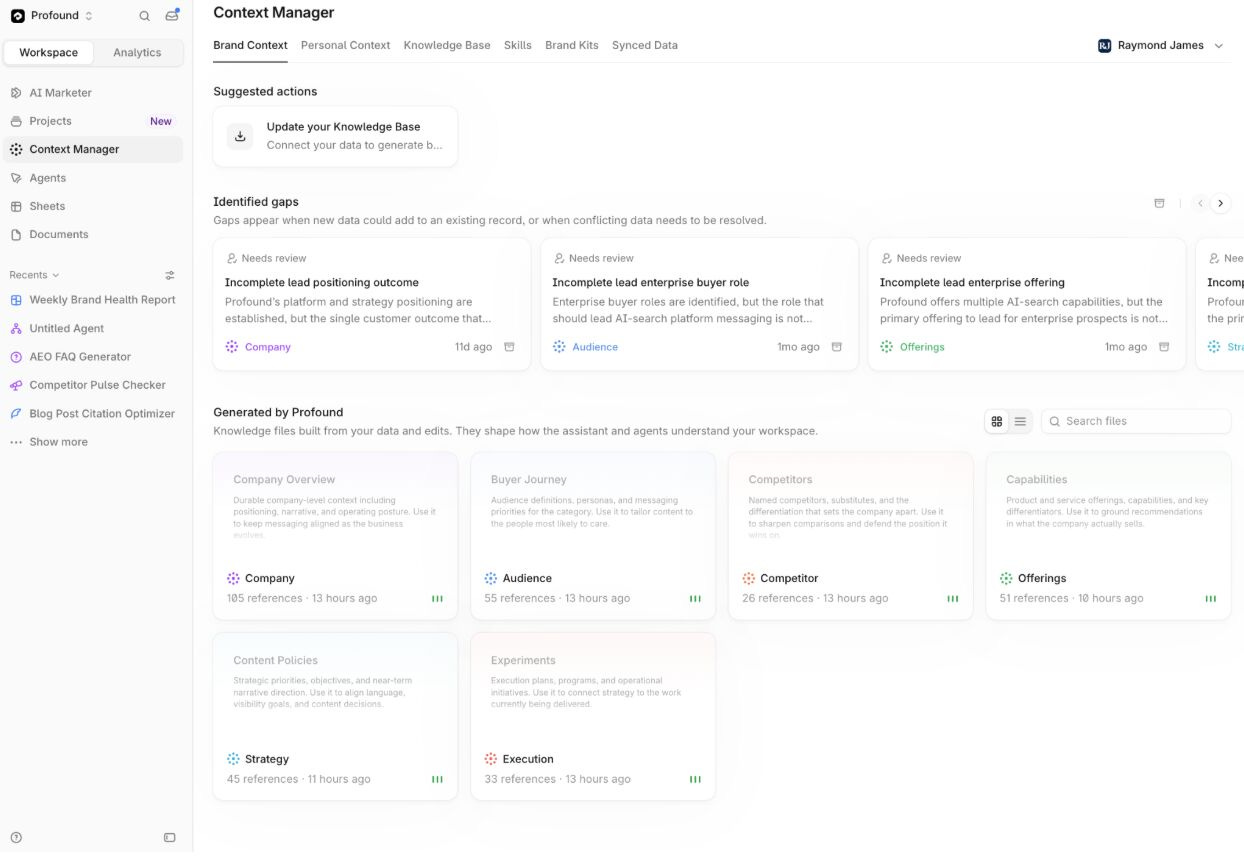
It brings together your brand voice, audiences, competitors, priorities, and team preferences, including preferred formats, review processes, and constraints. It draws from documents, approved connected conversations, and interactions with Aim. That context carries across projects and grows, so you don’t have to repeat the same instructions for every task.
Aim uses it to spot relevant opportunities and shape messaging, analysis, and workflows around what matters to your team. Less time explaining your business. More work that reflects it.
• • •
🖼️ Behind the Scenes
My friend Vitalii, who runs a $40m/year company called Stan, did something unheard of.
He made a bet that only someone insane would do.
He rented out a 400-acre summer camp in the Poconos and invited 100 entrepreneurs to come lock in for two weeks.
Then he invited Gary Vee, Michael Ovitz (founder of CAA), and a bunch of other experts to come mentor them.
Finally, he invited Mr Beast’s former content team to film the whole thing as a reality show.
It cost him a few million bucks.
I was grateful he invited the Fibe team and me to spend a few days there shooting content and meeting the founders. I can’t share too much on what I saw, but I was shocked at what he pulled off.
Vitalii’s belief is that 10X more people will become entrepreneurs in the coming years. I agree with him
Still can’t believe he took over a summer camp though.

The weekly accomplishments email is a strong habit, and it works better when it is short and tied to outcomes. Three lines covering what moved, what it changed for the team, and what is next gives a manager something they can forward when promotion decisions get made without you in the room.
Andrew, this post hit me at the right time. I've been working in digital marketing for almost 10 years since college, and it's been a struggle to increase my salary in the US. I thought I was being original by staying loyal to my companies while my coworkers jumped jobs every 2 to 3 years. I figured they were after a quick cash grab and I was the one showing loyalty. But my raises were minimal, and I stayed five years at my first company. I was also too timid at salary negotiation, even though I had taken a course on it.
In nine years I've only had three jobs: five years at the first, four at the second, and six months at my most recent one. I fell into a comfort zone where things were fine enough that I never looked around. I should have checked the market every year, or even jumped. The pay increase from my first job to my second was huge. I also wish I had more control over my job searches. Each one felt a bit desperate as the months rolled on, which is part of why my titles are all over the place, from digital strategist to marketing analyst and now social ads content planner.
Moving again feels uncomfortable. I just moved to a new state and got all my furniture in, and I don't want to move or take a longer commute. Still, I think applying every year from now on is the right move, so I can head toward a job I enjoy that pays more and has a better balance between work and life.
My most recent job proves your point more than ever. I planned launch dates and A/B strategy for social ads at a big company with five brands we all know. Behind the scenes, it was 10 times more disorganized than any company I've worked for. Everything ran on confusing spreadsheets and emails, with way too many terms and invented names for spreadsheets, and about 30 new emails a day. Many people told me it's the most confusing, frustrating, stressful company they've worked for. I think part of it is that it grew to millions in ad spend in just 2 to 3 years across too many teams.
Long story short, they took me off the team after six months because I wasn't meeting expectations. I reflected and learned what I could, but it wasn't all me. After I left, many people told me how disorganized it is and that I wasn't alone. Managers had little to no visibility into my work, even though I tried to include them. Having 4 to 5 meetings a day didn't help either. I started sending weekly status updates near the end, but it was too little, too late. I'll keep doing it at my next job, especially at messy companies like this.
I'm staying optimistic. Years ago I bought an expensive course from an expert that has served me well, and this time I'll use it more intentionally to find my dream job. I rushed the process and didn't research this company enough, and I've learned from that.
Your LinkedIn point is interesting, but I'm not sure anyone would read it. I post often, but posts disappear from the feed fast and each one may only get 100 views. I could write articles or add things to my profile, but I'm not sure anyone would read them or if they'd stay relevant. I'll think about how to optimize my LinkedIn, though, because you're right that my achievements get lost inside whatever team or company I work for.