


👋 Friends,
It’s my last day in SF today but I’ll be back in October. Tomorrow I head to Atlanta, then following that, back to New York then Copenhagen. Enjoy today’s article and our upcoming events programming.
I’m also actively making angel investments, so if you are raising your first or second round, please hit reply to tell me what you are building. I will respond if it’s a fit.
📅 Upcoming Events
Aug 18 | 💻 The AI Dev Stack: Beyond Code (SF) – Join Fireworks, Braintrust, Browserbase & Antimetal for an evening on how AI is changing the way software gets built, shipped, and maintained. Not my event but highly recommended.
Aug 19 | 🍽️ Junto Founder Dinner (NYC) – Founders and CEOs only.
Aug 20 | ☕ Breakfast & Fireside Chat w/ Henrik Werdelin, Founder of BarkBox (NYC) – With my friend, Henrik, the founder of BarkBox (NYSE: BARK) to discuss building companies in the AI era.
Aug 20 | 🍽️ AI & Marketing Salon #4 (NYC) – Salon dinner to discuss the future of marketing. We have two seats left for CMOs & VPs of Marketing.
Aug 25 | 🌇 August Tech Rooftop Mixer (NYC)
Sep 1 | 🖥️ (Virtual) Mindsets of $1B Founders w/ Ankur Nagpal & Andrew Yeung – With my friend Ankur, who sold his first company Carry for $250M and is now a General Partner at AngelList’s USVC fund.
Sep 3 | 🖥️ (Virtual) Lessons From Scaling to $1M+ Without Raising Venture Capital w/ Andrew Yeung
Sep 10 | 🍽️ AI & Marketing Salon #5 (NYC) – Salon dinner to discuss the future of marketing. We have ten seats for CMOs & VPs of Marketing. Special guest to be announced!
Sep 17 | 🖥️ (Virtual) The IRL Advantage: How to Turn In-Person Connections into Lasting Relationships w/ Goodword
Oct 14 | 🍽️ Junto Founder Dinner (SF) – Founders and CEOs only. Michelin-starred restaurant.
Oct 15 | 🍽️ Extraordinary Founders Dinner (SF) – Join me and a dozen vetted Series A, B, C founders for dinner at a Michelin-starred restaurant.
Nov 5–6 | 🗽 The Outliers Summit (NYC)
• • •
Lessons From Scaling to $1M+ Without Raising Venture Capital (Pt. 1)
I never wanted to be an entrepreneur. Instead, I fell into it while trying to solve a problem for myself that apparently many others had. I didn’t raise a dollar of venture capital nor did I have a check from my trust fund (in fact, my parents pleaded with me NOT to quit my job at Google). And I didn’t have a co-founder, advisors, or a board either.
To date, Fibe has generated millions of dollars in profit, and earlier this year I started another company, The Shortlist, to help startups find the best talent, which has just begun to hit profitability. I also co-founded the Outliers Summit, which operates independently as a profitable events and media company and will soon hit the 7-figure mark.
The best part: I spend my time doing work I love, bringing people together and creating content. For the most part, I answer to nobody, and I own my companies outright.
I believe that most entrepreneurs should consider bootstrapping before other options, but I don’t think bootstrapping is morally superior to raising money in any way. Raising is the right call when you're going after a winner-take-all market, or when you need capital to reach escape velocity, but most people default to raising as their first instinct, when the truth is that most businesses don't need it. Mine didn't.
Also, before we get into it: I'm hosting a live webinar on September 3 where I'll go even deeper on everything in this piece. How I bootstrapped to seven figures, the games worth playing, the mistakes to avoid, and the systems that make it all run. It'll be part teaching, part live Q&A, so bring your questions.
Here are the ten lessons I learned scaling my business to $1M+ without taking money from investors. Part one!
• • •
1. Pick your game before you start
The most important decision you’ll make is what game you’re playing, and most people never consciously make it.
Do you want to build a billion-dollar tech company? Do you want to be venture-backed? Do you want to run an agency or consultancy? Or sell physical products as a direct-to-consumer eCommerce company? How about building apps? Or do you want to be a content creator?
Each game has completely different rules, economics, and outcomes. Advice that is gospel in one game might be malpractice in another. A friend who's opening a rock-climbing gym asked me for business advice, and I was honest: I have absolutely no clue.
Before you start, it’s helpful to map out the trajectory of the business through branching logic. Where does it lead? What does year five look like? What kind of life does the CEO have?
You should pick the type of business you start based on the life you want, not the other way around.
I knew that I did not want to (1) raise venture capital or (2) run an agency because I had never met someone who did those things and felt they were genuinely free - and independence is my most important value.
2. You probably don't need to raise money
Too many entrepreneurs treat raising money as step one - as their first instinct the moment they decide to start. Usually it’s driven by fear.
But most businesses do not need outside money beyond, at most, a small initial round to have a cushion. Call it $50,000-$100,000. Plenty of businesses need nothing at all. I didn’t raise anything. I funded the business with the revenue.
If it’s your first time building something, the trick is to choose a model that doesn’t require a big upfront investment or a long break-even period. Media companies, service companies, and software businesses can often start generating cash almost immediately. Restaurants and brick-and-mortar retail can’t. There are more than enough business models that let you skip that pain entirely. Pick one of those.
3. Start while you still have a cushion
The best way to start a business (especially if it’s your first) is to start before you need it to work.
Build it on the side while you still have a W2 job or another source of income. When you’re not dependent on the business making money next month, you make better decisions. You don’t take bad clients or bad terms out of fear. You give the thing room to find its footing. You’re not desperate.
Desperation is expensive and forces you to make choices from a weak position.
4. In the early days, you are the business
In year one, there is no separating you from the company. You are the product manager, the sales team, the marketing department, the support desk.
That means two things:
First, finding customers is everything. In the early days, you should orient almost all of your time around finding customers, serving them well, and building a business model that makes economic sense. Nothing else matters as much.
Second, because you are the business, taking care of yourself is a business decision. Your physical health (hardware) and your mental health (software) are all company infrastructure. If you break down, the company breaks down. Do not neglect sleep, nutrition, rest, and exercise.
5. Social proof is critical early
When you’re new, your customers have nothing to judge you on.
So they quickly form impressions based on your social proof, brand, and credibility. These first impressions are extremely hard to change later.
So you need to provide as much proof as possible. Display testimonials, show logos, and capture photos from your events. Every piece of proof you collect early keeps working for you long after.
6. Distribution > Product
An average product with a loyal audience beats a great product with no audience every single time. This is MORE important than ever with the commoditization of software.
I started building an audience on LinkedIn in 2019, and this is the single biggest reason I was able to bootstrap. I spent years building an audience before I had a business idea. Greg Isenberg even has a helpful framework called Audience, Community, Product (ACP).
One thing to look out for: Building an audience in service of your business is one of the highest-leverage things you can do. BUT trying to be a full-time content creator and a serious entrepreneur at the same time is a trap. Content is seductive and distracting, and I’ve watched many founders quietly optimize for vanity metrics, likes and followers, instead of building a good business underneath.
Build the audience to feed the business. Don’t let the audience become the business unless a media company is the game you’ve chosen to play.
7. Solve expensive problems for customers who can pay
This is the advice that experienced entrepreneurs tell me over and over again.
The reason most entrepreneurs prefer B2B to B2C is that businesses have much more money to spend than everyday consumers. A small business will spend tens of thousands of dollars on painkillers to help it run. The average consumer, by contrast, might complain about paying $20/month for a subscription.
I decided early on not to go the consumer route - that is, we host 100+ events a year, but 99.9% of them are free. The only event that is ticketed is our Outliers Summit and that’s because it’s a multi-day event with many experiences included. I wanted to sell to enterprises that would not think twice about writing a $50,000 check, such as banks, law firms, recruiting companies, software companies, and many more.
The same amount of effort spent serving customers with money returns far more than serving customers without it.
8. One channel is enough to reach one million dollars
I learned this from building my own company and from advising a dozen other early-stage startups. All you need is one marketing or sales channel to reach a million dollars in revenue. Often, that’s LinkedIn for B2B and TikTok for B2C.
Think about that for a sec: You can generate a million dollars of revenue for your company by posting on LinkedIn or making videos on TikTok. You have to be good at it, of course, but getting there might only take you a few months.
Don’t chase five marketing channels too early. Pick one where you have an unfair advantage and go deep before you go wide. Then build referral and affiliate loops on top of it and incentivize your happy customers to bring you more customers.
9. Spend on marketing only when it ties to revenue
In the early days of your business, CUSTOMERS are the lifeblood of your business, and every dollar you spend should trace back to them.
Tie every single marketing dollar to an outcome. Performance marketing is great because it’s measurable. The same logic extends to channels that are tangible, like hosting a dinner for prospects.
What you want to avoid early is spending on brand for brand's sake, before you've proven you can turn attention into customers.
10. Stay lean and sell the mission
It’s impossible to be competitive on compensation as a small business, so you have to offer the intangibles. Things like mentorship, team, learning, and experience, or selling the company's mission incredibly well.
At Fibe, we believe in the concept of a “tour of duty” - work with us for 12 to 18 months in a demanding, high-intensity role, and we'll amplify your personal brand and make sure you're well-networked with the most influential people in tech. That's why many of our team members now have tens of thousands of followers on LinkedIn and are close with dozens of founders, CEOs, and CMOs.
You want people who are there for the mission, not people optimizing for a paycheck you can't match.
Two more things:
Before you hire someone to do a job, you should first do the job yourself and understand it before you can delegate it. Then lean on part-time people, contractors, and interns before you commit to full-time headcount.
Use AI relentlessly. It has transformed what a small team can do. You can now automate huge amounts of coordination, logistics, scheduling, and even design. This is a big part of how we run over a hundred events a year with a tiny team.
Where this leaves us (and what's coming in Part 2)
Everything in Part 1 was about the foundation - picking the right game, avoiding the reflex to raise, staying lean, and understanding what kind of business you’re building.
But choosing the right business is only half of it. Running it well is a different skill entirely.
That’s what Part 2 is about. The lessons I learned once the business was already off the ground, and the mistakes I made along the way so you don’t have to repeat them.
See you there
…
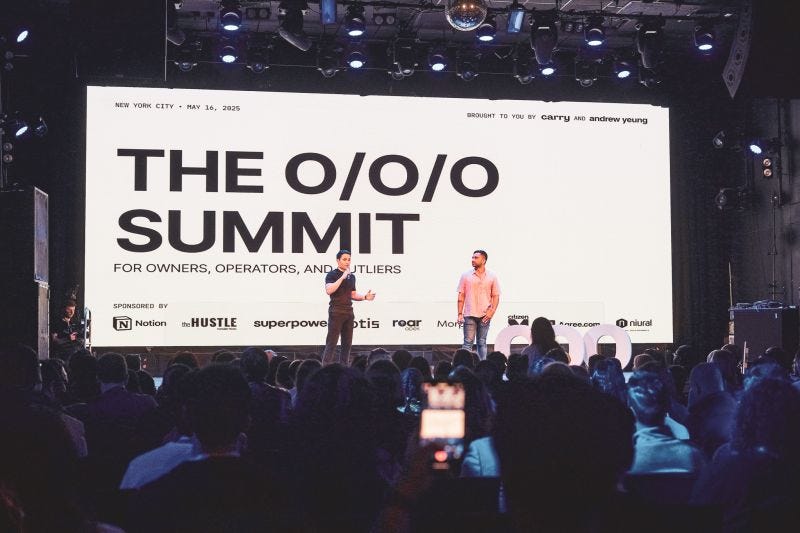
Oh, and if reading this made you want to be in a room full of people building interesting things, come to the Outliers Summit on November 5 and 6 in New York.
It's two days with founders, operators, and builders who took the unconventional path, many of whom bootstrapped their way to something meaningful.
Day one is how outliers build. Day two is how outliers think. If you've been circling the unconventional path, the fastest way I know to get onto it is two days around people already on it.
👉 Get early bird tickets here (only a few remain)
• • •
💃 Tech Community Plugs
Resources for entrepreneurs, investors, and tech professionals.
💼 Hiring top GTM & engineering talent in NYC? Apply to pitch at our monthly Shortlist founder showcase and meet the top 1% operators from my network.
🇺🇸 Looking for help with US immigration? Reply here – I’ll connect you with the attorneys and team I trust for visas, green cards, and all the corporate immigration matters.
🍽️ InKind – the ultimate dining app for foodies … earn up to 30% back when you eat out, plus get $50 off your bill every month at select spots. And as a bonus, we both get $25 free when you sign up. Sign up here.
🏢 Looking for an office space in NYC? I know of a few great spots opening up. Hit reply if you’re searching.
👀 Profound just got a MAJOR upgrade with Profound Sheets. Profound Sheets lets you run hundreds of AI agents in parallel, saving you hours of time. Learn more here.
🚀 Forum Ventures just opened applications for their next Builders Between Ventures cohort. Three weeks to find out if your idea is a real company, no cost, no equity, and a real shot at a $250K investment. Apply here.
🧮 Need a CPA? I’ll introduce you to Alex, with whom I’ve been working for the past three years. He’s excellent and specializes in tax support for high-earning individuals and entrepreneurs. More info here.
🏦 Fidelity Private Shares is the best-in-class equity management platform with 409A valuations and a secure data room. With Fidelity Private Shares, you’re always fundraise-ready. To learn more, reach out to Charlie Stephens at Fidelity for support! Learn more.
💸 Fundraising – Are you raising capital? Get your startup in front of my network of 2,000+ top-tier VC investors, angel investors, and family offices. Sign up here.
📈 Investors – Looking for deal flow? Receive curated deal flow from my network in your inbox every month. Sign up here.
What other perks should I include? Let me know.
• • •
🤝 You’ve built an incredible network. Now use it.
Part of my mission is to help you build deep, meaningful relationships. That’s also why I became an angel investor in Goodword.
Goodword is the modern relationship manager. It helps you remember the context behind every relationship and stay meaningfully in touch long after the dinner, mixer, or conference ends.
Friends of Andrew can get $100 off an annual subscription: $199 instead of $299. Start your free trial at goodword.com and use code FRIENDOFANDREW at checkout.
• • •
💸 Affiliates
Founders, make $$$ by booking calls!
Over the years, I’ve partnered with VC-backed software companies that will pay you to take a 30-minute call with their sales team. If you’re a founder or CEO, you probably qualify for most of these.
Block off one day, take a dozen calls, and walk away with $$$. I call it Uber Black money. All you have to do is take the call.
Rho (up to $1,350) – All-in-one banking and financial automation platform for startups.
Superpower (up to $240) – A proactive health platform that tests 100+ biomarkers annually to detect early signs of 1,000+ conditions — giving individuals and teams actionable health intelligence for $17/month.
Highbeam (up to $1,750) – AI financial command center for consumer brands.
Numeral (up to $2,150) – AI for sales tax and compliance across states and countries.
North.Cloud (up to $500) – Cut AWS and GCP costs.
WithCoverage (up to $750) – A modern risk management for consumer-focused businesses. 1,000+ customers with 99.9% retention.
Secure Cloud Innovations ($250) – An embedded cybersecurity consulting/consulting team for B2B SaaS companies.
• • •
🖼️ Behind the Scenes
Pups and I made it on a Times Square billboard!
I started this bi-weekly email newsletter six years ago, and all the great things in my life have come from it.
And earlier this year, I started the Shortlist NYC newsletter too, which I’ve built exclusively on beehiiv. Every week we share the top startup jobs in New York that you should know about. See it here.
I’m grateful to beehiiv for championing creators and have a ton of admiration for Tyler Denk as a founder.

Maybe you will find this interesting www.square43.com
We are hitting 1m every year
Would love to reconnect and share the capital access platform I’m building! We just opened our angel round 👼