👋 Friends,
We are approximately 70% through the year, and summer officially ends in a week. Where did the time go?
I recently came across a staggering statistic: a third of your life is spent at work. That means a huge share of your happiness, your quality of life, and your fulfillment comes down to your career. The right job can change your entire life, but the wrong one can drain it.
Today’s essay is about identifying the right signals to join a life-changing company.
📅 Upcoming Events
Sep 18 | 🖥️ (Virtual) Lessons From Scaling to $1M+ Without Raising Venture Capital w/ Andrew Yeung
Sep 28 | 🗽 The Shortlist: September Founder Showcase (NYC) – Meet the founders/CEOs of the fastest-growing tech companies in the city.
Sep 29 | 🌇 September Tech Rooftop Mixer (NYC) – Join our must-attend event for founders, investors, and tech professionals shaping the future. Hosted at an iconic, massive venue in the heart of NYC.
Sep 30 | 🍽️ Junto Founder Dinner (NYC) – Apply to attend. Join a handpicked group of early-stage venture-backed NYC CEOs and founders for dinner on me.
Sep 30 | 🚀 MongoDB.local NYC – Attend to see best practices and technologies from NYC’s top AI builders. [PARTNER EVENT]
Oct 2 | 🐶 tech pawty (NYC) – Hosting a founder coffee social at Puppysphere - an original puppy experience. Come and hang with the cutest doggos (and founders) in the city.
Oct 4–19 | 🚀 Launchpad by Stan (NYC) – A two-week experience for aspiring founders to launch their companies in public and compete for cash prizes and capital investments from top investors. Fibe has 5 spots - use FIBE for expedited approval
Oct 14 | 🍽️ Junto Founder Dinner (SF) – We’re back in SF! Founders and CEOs only. Michelin-starred restaurant.
Oct 15 | 🍽️ Extraordinary Founders Dinner (SF) – Join me and a dozen vetted Series A, B, C founders for dinner at a Michelin-starred restaurant.
Nov 5–6 | 🗽 The Outliers Summit (NYC) – Spend 2 days with the unreasonably ambitious builders in New York. Get your tickets before prices go up!
• • •

As a community builder and “super connector,” I have the privilege of not only helping people land their next role, but also seeing the patterns that emerge over time based on their career decisions.
I get asked this question constantly: How do you choose the right company to work for?
It usually comes from one of four places
The friend leaving a big tech job who finally admitted they're bored
The new grad staring at two or three competing offers, paralyzed
The person who is burnt out of their current role
Or the founder whose company just wound down, sitting in the in-between, trying to figure out the next move.
I used to be terrible at answering this because, for years, I optimized for the wrong things. I looked at the title, the salary, the big logos. And it took me a long time and a few mistakes to understand that these can be the least important factors.
I’ve spent the last few years pattern-matching and talking to executives, founders, and CEOs who eventually made the right career choices, leading to either great financial outcomes or a fulfilling pursuit of meaningful work.
These are the patterns I’ve observed that lead to successful career bets.
1. Choose the market, not the job
A counterintuitive insight: a strong market pulls success out of even the most mediocre companies.
That means the sector you choose matters more than the specific company and far more than the specific role.
Elad Gil, an early employee at Google and one of the world’s most notable venture capitalists, says that early in your career, the market trend you ride may be the single biggest determinant of your success.
A rising market means more opportunities inside your own company and more companies competing to hire you later, but a shrinking one means the opposite. So before you evaluate the company, evaluate the market. Is it growing? Do you expect it to be much larger in 5 years?
2. Optimize for the network you’re joining.
The network might be the single most important thing to optimize for in a job, yet it’s also a factor that people most consistently underrate.
Your network doesn’t only mean your manager, but the entire constellation of people around the company: The founders, early employees, investors, advisors, customers, even vendors.
A classic example is the PayPal mafia that seeded LinkedIn, YouTube, Tesla, SpaceX, and Yelp. If you were in that group, you had a career full of outside opportunities for the next few decades, no matter whether you were brilliant or just lucky.
The same is true of the early Google diaspora, who now sit at the top of every single major tech company and venture firm.
So when you evaluate a company, figure out who you’ll be surrounded by. Look at the companies. Look where the companies’ former employees end up. If the alumni go on to build and lead great things, that tells you a lot.
3. Pick the job with the highest rate of learning
Sam Altman has a rule of thumb: avoid any career where someone with 2 years of experience can be as effective as someone with 20. Your rate of learning should always be high.
The most effective environments are the ones where you feel slightly out of your depth when you’re surrounded by people who are better than you and force you to accelerate your growth just to keep pace
Pick the companies where you’re the least experienced person, not one where you’re the smartest. The old adage holds true: if you’re the smartest person in the room, you’re in the wrong room
4. Stop overrating role and compensation
If you join a rocket ship but land in a seat you don’t love, you can almost always move seats once you’re inside. Example: If you want to be a product manager but can only get hired into the operations team at a great company, take it anyway. If you’ve picked the right company, opportunities to move around will open up as it scales (But this is usually only true if you join a high-growth company).
Early on, compensation shouldn’t be an important factor either. Owning 1% of a mediocre company is much worse than owning 0.1% of a great one. One may be worth zero, while the other could be worth a thousand times more.
The same goes for cash. At a great company, your cash pay will accelerate over time because winning companies eventually pay above market. Salary seems to be what people fixate on most, but it matters least early on. Trade short-term compensation for long-term growth unless you desperately need the cash right now, which is a valid exception.
5. Weigh optionality: does this open doors?
And lastly, don’t just default to something familiar. A tangible way to define optionality is the number of future jobs the next one will unlock. Have you been doing the same kind of work in the same kind of industry over and over again, or does this next role set you up to do something new, to move into a different market or a different function down the road?
I've watched many successful operators move laterally, from product to marketing to sales, just to get breadth of experience early. In the moment, this can look disorganized, even aimless. But the truth is that with AI, most roles are converging, and entirely new categories of work are forming. Early in your career, it's better to gain breadth than to go deep.
• • •
I love talking about this more than anything, and the honest reason is that I believe finding the right opportunity can completely change your life. I’ve seen it happen too many times. Someone joins the right company at the right moment, and five years later they’re a different person. Financially, they might have the options they’ve never imagined, but it’s also so much more than the money.
P.S. I'd love to help you find your next role. Two ways I can help.
Are you looking to hear about roles from breakout tech companies in New York? Sign up for our talent network here to receive emails about jobs.
Do you want to meet founders and CEOs of the fastest-growing startups in New York? Attend our monthly Shortlist Founder Showcase.
And if you’re a founder who wants to hire top talent, please hit reply and let me know what you’re looking for.
• • •
🚀 Spend two days with the most ambitious builders in New York (Nov 5-6)
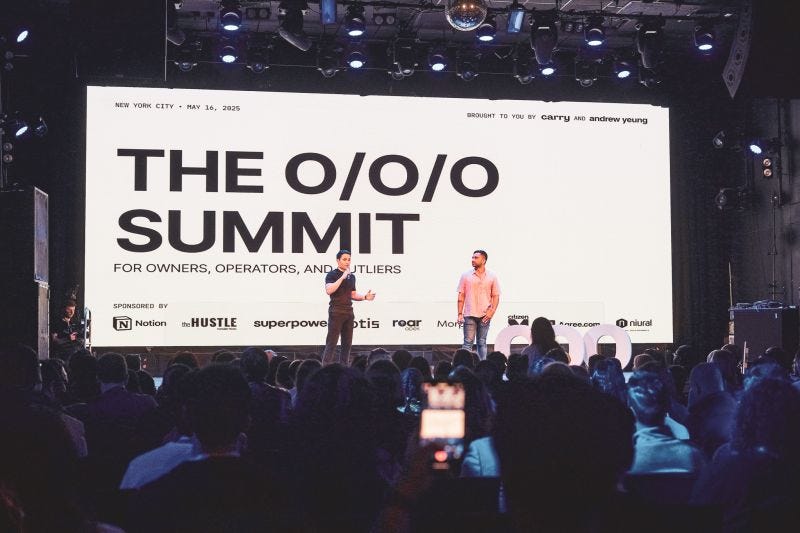
The Outliers Summit is almost here. Two days in NYC, November 5 and 6, with the founders, operators, and builders who took the unconventional path, and the people about to.
This year’s speakers include Sam Parr (The Hustle), Carina Hong (Axiom Math), Ryan Hoover (Product Hunt), Sahil Lavingia (Gumroad), Andy Dunn (Bonobos), Zach Sims (Codecademy), Nat Eliason (Founders School), Nik Sharma, and Nadya Okamoto (August).
Built for the unreasonably ambitious builders, creators, business leaders who want to build something extraordinary.
Day 1 (Nov 5): Tactical sessions where you leave having built the thing yourself – an app, an agent, an audience, a brand.
Day 2 (Nov 6): Off-the-record conversations about the bets and mindsets that separate outliers from everyone else.
Heads up: ticket prices go up in a week, and only a limited number remain.
• • •
💃 Tech Community Plugs
Resources for entrepreneurs, investors, and tech professionals.
✍️ Your AI Head of Content. I've been using Stanley for months, and it's the only reason I could run two companies and still grow 100K+ followers this year. It texts me what to post, tells me what's working, and auto-schedules everything from my iMessage. Free to try for 30 days with code ANDREW, here.
💼 Hiring top GTM & engineering talent in NYC? Apply to pitch at our monthly Shortlist founder showcase and meet the top 1% operators from my network.
🍽️ InKind – the ultimate dining app for foodies … earn up to 30% back when you eat out, plus get $50 off your bill every month at select spots. And as a bonus, we both get $25 free when you sign up. Sign up here.
🏢 Looking for an office space in NYC? I know of a few great spots opening up. Hit reply if you’re searching.
💡 Sitting on a startup idea that won’t quit? Forum Ventures is accepting applications for The Foundry, their five-week studio sprint where you get access to their internal validation and diligence process to find out if your idea is a real B2B company. No cost to participate, and a shot at a $250K investment. Apply here.
🧮 Need a CPA? I’ll introduce you to Alex, with whom I’ve been working for the past three years. He’s excellent and specializes in tax support for high-earning individuals and entrepreneurs. More info here.
🏦 Fidelity Private Shares is the best-in-class equity management platform with 409A valuations and a secure data room. With Fidelity Private Shares, you’re always fundraise-ready. To learn more, reach out to Charlie Stephens at Fidelity for support! Learn more.
🇺🇸 Looking for help with US immigration? Reply here – I’ll connect you with the attorneys and team I trust for visas, green cards, and all the corporate immigration matters.
💸 Fundraising – Are you raising capital? Get your startup in front of my network of 2,000+ top-tier VC investors, angel investors, and family offices. Sign up here.
📈 Investors – Looking for deal flow? Receive curated deal flow from my network in your inbox every month. Sign up here.
What other perks should I include? Let me know.
• • •
🖼️ Behind the Scenes
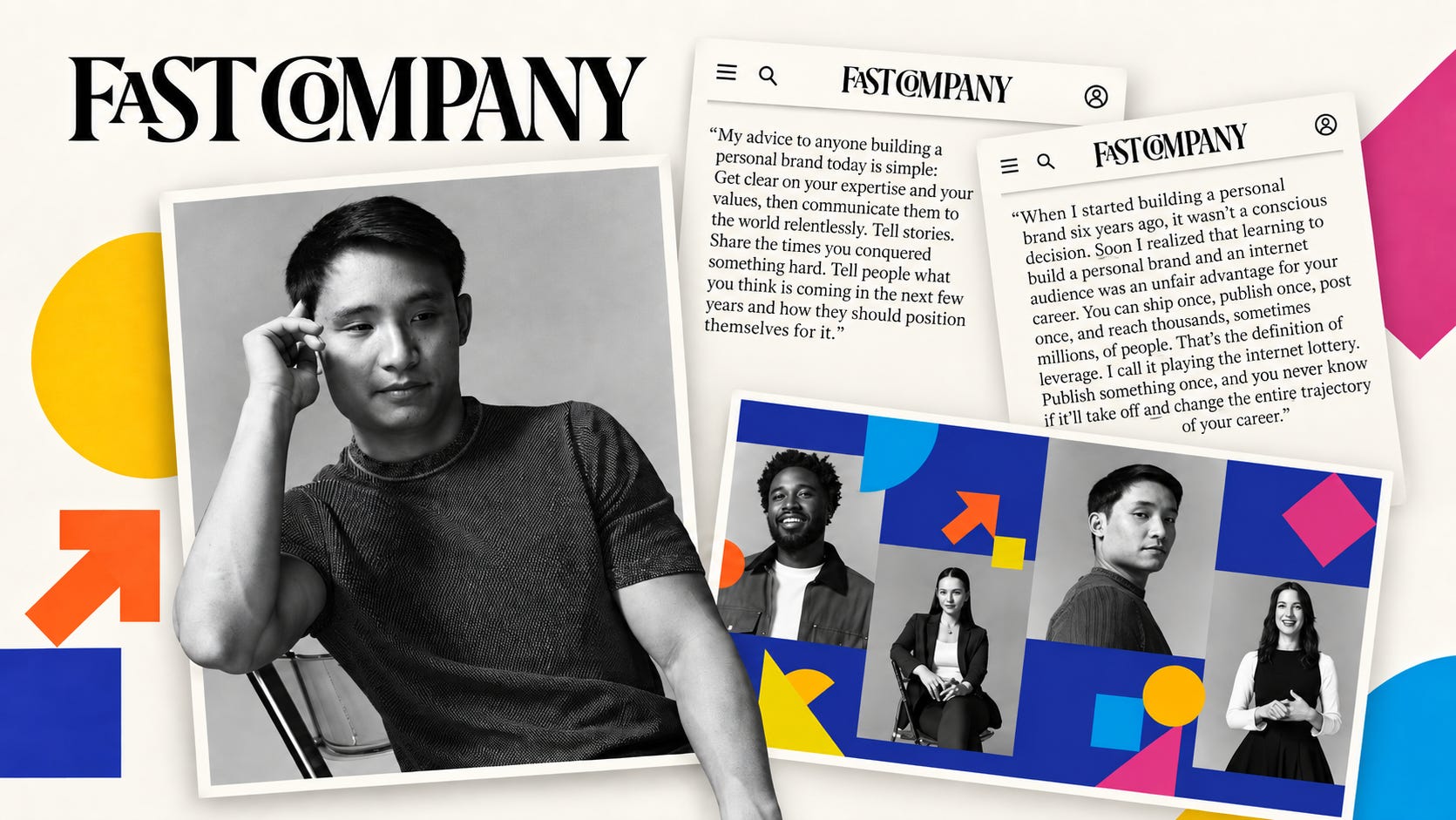
I’m grateful to Fast Company for featuring me in their editorial report on the new rules of personal branding. You can read the full article here.
Two things on personal branding are worth sharing here:
1. Building a personal brand is like playing the internet lottery. Publish something once, and you never know; you might end up reaching millions of people and changing the entire trajectory of your career. Worth a shot.
2. Some people think personal branding is cringe. But the biggest difference I've noticed between the people who do it and the people who don't is this: the ones who do care enough to try. They care about their craft. They care about their career. They care about the outcome. And I've come to believe there's almost nothing more admirable than watching someone put themselves out there and go for something.